
Skagit County Jail Alternatives Program Overview
Skagit County Jail Alternatives Program is operated through the Skagit County Jail and Corrections Division. The official program page says the program was created in 1995 to reduce overcrowding in the jail. Its address is 600 S. Third Street, 2nd Floor, Mount Vernon, WA 98273, with phone contact at 360-416-1940 and email contact at ALTS@co.skagit.wa.us. The program is part of the broader jail system, but it is different from the Skagit County Community Justice Center at 201 Suzanne Lane.
The research identifies the program as a work-release and community-custody jail alternative. It includes Electronic Home Monitoring, Community Service Work Program or Litter Crew, and Work Release. Official jail material also refers to in-custody workers and a court coordinator. The key public-record point is that a person may appear in Skagit County jail records even when the listed custody location is not a standard cell assignment. Roster entries observed in the research can show ELECTRONIC HOME MONITORING or MALE WORK RELEASE (E102) as jail housing locations.
Use the Jail Alternatives Program information for court-approved adult offenders serving a jail alternative. Do not use it for general state probation or parole, and do not use it for juvenile detention. Sentenced state-prison custody moves to the Washington State Department of Corrections system. Juvenile custody is handled by the Skagit County Office of Juvenile Court. Federal and immigration custody use separate BOP and ICE lookup channels when those authorities control the case.
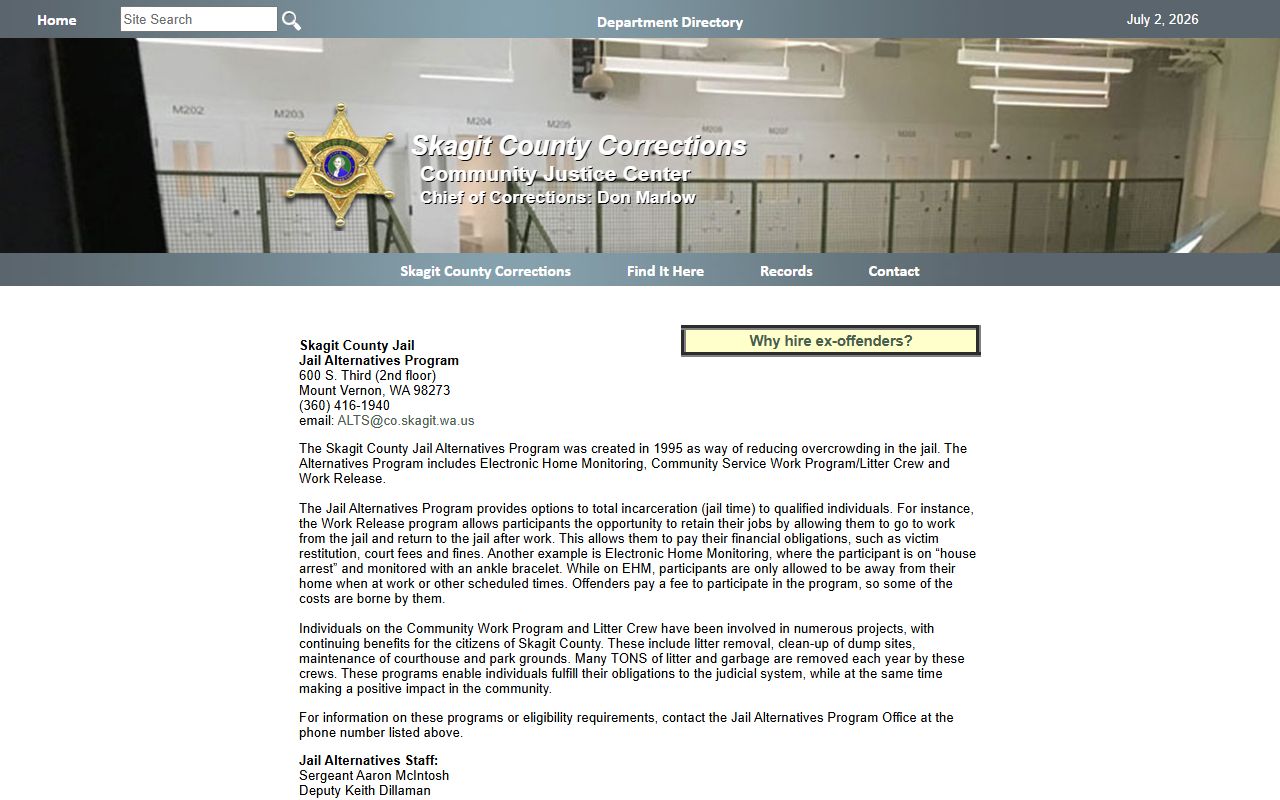
The county's official Jail Alternatives page describes electronic home monitoring, work release, community service, litter crew, and the program contact block.
Because the program is compliance-based, confirm reporting instructions directly with the Alternatives Program rather than assuming regular jail lobby or cell-housing rules apply.
Jail Alternatives Capacity and Population
No official capacity number for the Jail Alternatives Program was located in the research. That gap matters because the program is not a single bed-count facility like the Community Justice Center. It covers alternatives such as electronic home monitoring, work release, community service work, litter crew, and in-custody worker assignments. County historical materials do document that the former jail had an out-of-custody program average daily population of 35 in 2001, but the research does not identify that number as the current alternatives-program capacity.
The adult jail roster can reflect alternative placements as part of the jail system. The observed 2026 adult roster count was 173 at the report run on July 2, 2026, but that count belongs to the adult jail roster as a whole, not a published Alternatives Program census. When the housing field says electronic home monitoring or work release, the record may still be relevant to the jail system while the person's day-to-day status differs from someone housed in a normal jail unit.
Lookup for Jail Alternatives
There is no separate public alternatives roster identified in the research. The lookup path remains the Skagit County jail roster and related adult jail reports. Start with the current roster, then check the booking report, release report, VINE, phone channels, and records-request process if the current report does not answer the question. The housing-location field is the most important part of the roster for alternatives because it can show ELECTRONIC HOME MONITORING or MALE WORK RELEASE (E102).
- Open the Skagit County current jail roster and check the report run time because the list updates every 15 minutes.
- Find the person's name in the report-style list. The roster is sorted by name and does not provide a normal search form.
- Expand the row and read the jail housing location before assuming the person is in a cell at the Community Justice Center.
- Look for alternative-location language such as electronic home monitoring or work release, then review arrest type, court, bail, and disposition rows.
- Call the Jail Alternatives Program at 360-416-1940 when program reporting, compliance, or office instructions are the issue.
The booking report covers people booked during the last 26-hour report cycle and is generated daily by 7:00 a.m. The release report covers people released from SCCJC during the past 48 hours who are not currently in the facility as of 6:00 a.m. If an adult jail alternative record is not visible online or a historical document is needed, use the Skagit County Sheriff's Office records route or the county's NextRequest public-records portal.
Jail Alternatives Address and Contact
The program office is listed at 600 S. Third Street, 2nd Floor, Mount Vernon, WA 98273. That is the same general South Third Street county-government area used by Sheriff's Office records and other county offices, not the 201 Suzanne Lane jail-visit address. The program phone number is 360-416-1940, and the official email listed in the research is ALTS@co.skagit.wa.us. Use those contacts for alternatives-specific reporting, compliance, and program questions.
Skagit County Jail Alternatives Program
600 S. Third Street, 2nd Floor
Mount Vernon, WA 98273
360-416-1940
ALTS@co.skagit.wa.us
Reporting for Jail Alternatives
The Jail Alternatives Program is not a standard jail cell facility, so adult jail visitation rules should not be copied onto every alternatives placement. If a person is assigned to electronic home monitoring, work release, community service, or litter crew, the important question is usually reporting and compliance rather than social visitation. Contact the Alternatives Program for the current reporting location, documentation requirements, schedule instructions, and any court-ordered conditions tied to the placement.
If the person is physically housed at the Skagit County Community Justice Center, adult jail video visitation rules may apply. Those rules include video visits from home or device, a lobby option at 201 Suzanne Lane, scheduling at least one day and not more than 14 days ahead, and matching the person's scheduled time out of cells. If the roster or court order indicates a jail alternative instead of jail housing, confirm with program staff before assuming a lobby video visit can be scheduled.
| Status | What to Confirm | Type |
|---|---|---|
| Electronic Home Monitoring | Program reporting and monitoring rules through Jail Alternatives | Community custody |
| Work Release | Work-release schedule, reporting, and custody location | Jail alternative |
| Community Service / Litter Crew | Assignment, schedule, and compliance instructions | Program placement |
| In jail housing | Adult jail video visitation rules at SCCJC | Video visit |
| Unclear roster location | Call the program or jail before travel | Verification step |
Mail and Money Rules
The research does not locate a separate public mail or commissary rule set for the Jail Alternatives Program. Do not assume that the adult jail's mail, commissary, and video-visitation rules apply to every alternatives participant. If the person is physically housed in the adult jail, the Community Justice Center rules apply: mail uses the inmate name, c/o Skagit County Jail, 201 Suzanne Lane, Mount Vernon, WA 98273, and money can be handled through JailATM, lobby kiosk, District Court kiosk, or money orders made payable to Skagit County Jail.
For people reporting to an alternatives placement outside a regular jail unit, contact the program office for instructions. The official program email and phone are the safer route for questions about equipment, schedule, employment verification, work release movement, community-service reporting, and program compliance. A roster listing alone does not explain every reporting rule or every court condition attached to the alternative.
| Service | Provider / Detail |
|---|---|
| Program Contact | 360-416-1940 or ALTS@co.skagit.wa.us |
| Adult Jail Mail | Use only when the person is housed at Skagit County Jail |
| Money Deposit | JailATM and jail kiosks apply to adult jail accounts, not every alternatives question |
Jail Alternatives Assignment and Intake
A person reaches Jail Alternatives through a court-approved adult custody path, not simply by choosing it from the jail lobby. The research describes the program as serving court-approved adult offenders and explains that official jail and roster materials can show alternative custody locations within the jail system. The roster still records custody details such as incarceration date, arrest date, arrest type, arrest agency, court, bail, and disposition when the person is represented in public jail records.
Skagit County roster examples include arrest types such as investigative hold, misdemeanor citation arrest, misdemeanor warrant arrest, misdemeanor commitment arrest, felony commitment arrest, DUI commitment arrest, and other county holds. A person may first be booked into the adult jail system and later assigned to work release or electronic home monitoring if the court and program conditions allow it. The court controls the order, while Corrections and the Alternatives Program manage the jail-system side of compliance.
If the record later moves away from county custody, the lookup channel changes. A sentenced state-prison transfer belongs in the WA DOC incarcerated search. A federal inmate belongs in the BOP locator, and an immigration detainee belongs in ICE ODLS. No adult state prison, federal detention center, or ICE detention facility was identified inside Skagit County in the research.
About Skagit Jail Alternatives
Skagit County's alternatives program exists because the county has long managed jail crowding through both secure custody and out-of-custody options. The research notes that the old jail opened with 83 beds, expanded over time, and still faced population pressure. County historical material recorded a 2001 in-house average daily prisoner count of 144 and an out-of-custody program population average of 35. The modern Community Justice Center was planned as a 400-bed Phase One facility, but alternatives remain part of the adult jail system.
The program's value for public records is practical. A name on the adult jail roster does not always mean the person is sitting in a standard jail cell. Housing and location values can tell a more precise story: jail pod, dorm, work release, electronic home monitoring, or another program-related status. Read the expanded roster row before traveling to a facility, scheduling a visit, or assuming the person can be reached through ordinary jail housing procedures.
Note: Confirm program reporting, custody status, and any visit or contact rules with Skagit County Jail Alternatives before taking action.